Xill4 Architecture
This page provides a high-level overview of the infrastructure and security architecture of Xill4. The diagrams are intended to illustrate the main components, connections, and security mechanisms used within a typical Xill4 environment.
The exact architecture can differ depending on the deployment, infrastructure, and external systems used by the customer.
Infrastructure
The Xill4 infrastructure consists of the Xill4 application, supporting data services, user access methods, and connections to both on-premises and cloud-based systems.
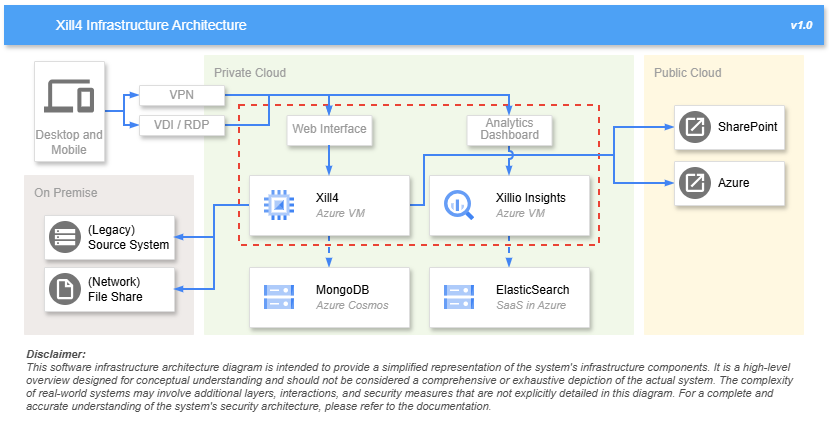
Infrastructure overview
Xill4 runs within the private cloud and can be accessed through the web interface, VPN, or VDI/RDP, depending on the configured environment.
The Xill4 application can connect to source systems located on-premises, such as legacy applications and network file shares. It can also communicate with public cloud services, including Microsoft SharePoint and Azure.
Supporting services are used for storing and searching data:
- MongoDB is used by the Content Store for storing application and migration data.
- Elasticsearch is used for indexing and search functionality.
- Xillio Insights provides analytics and reporting capabilities based on the available migration data.
The exact deployment of these services can vary.
Security
The security architecture shows how users, internal Xill4 components, and external systems communicate with each other and which security mechanisms are applied.
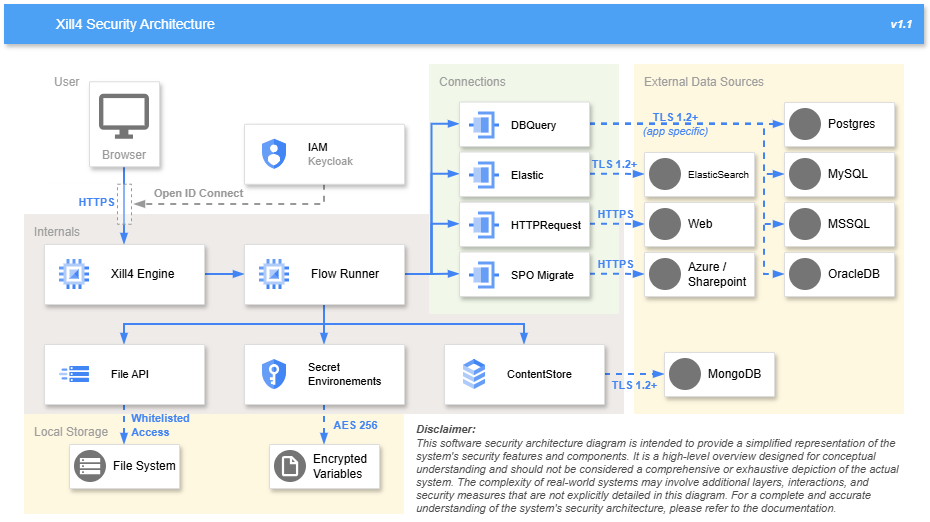
User access and authentication
Users access the Xill4 web interface through a browser using HTTPS.
Authentication and identity management are handled through an Identity and Access Management provider such as Keycloak. Xill4 uses OpenID Connect for authentication between the application and the identity provider.
Internal components
The Xill4 Engine coordinates the application and communicates with the Flow Runner, which executes migration flows and interacts with the configured source and target systems.
The Flow Runner can make use of several internal services:
- File API for controlled access to files on the local file system.
- Secret Environments for securely storing sensitive configuration values.
- Content Store for storing migration-related information and application data.
Access to the local file system can be restricted using whitelisted paths, ensuring that Xill4 can only access explicitly configured locations.
Sensitive values stored in Secret Environments are encrypted using AES-256.
External connections
Xill4 can communicate with different external systems depending on the components used in a flow.
Examples include:
- PostgreSQL
- MySQL
- Microsoft SQL Server
- Oracle Database
- Elasticsearch
- MongoDB
- Web APIs
- Microsoft Azure
- Microsoft SharePoint
The protocol and security configuration depend on the type of connection and the capabilities of the external system.
Where TLS is used, connections can use TLS 1.2 to protect data while it is being transmitted. HTTPS is used for web-based services such as APIs, Azure, and SharePoint.
For database connections, TLS support and configuration may also depend on the database server, driver, and connection settings.
Deployment considerations
The diagrams on this page provide a simplified representation of a typical Xill4 deployment. Actual environments may include additional infrastructure and security controls.
The exact configuration should therefore always be verified against the deployment and security requirements of the environment in which Xill4 is installed.